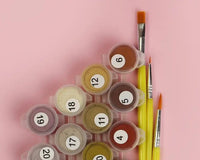
Every paint by numbers kit in the range is offered in three versions, and the choice between them changes both the price and the amount of work that stands between you and something you can hang on a wall. The difference at the smallest size is about twenty-two dollars, and at the largest, it is closer to fifty-nine. It is worth understanding what each option actually gives you before you add a kit to your cart, because the decision is difficult to reverse once the paint is dry.
What the Three Options Actually Mean
The three choices are not variations in quality. They are variations in how much preparation has already been done on your behalf, and once you see them that way, the price differences make sense. The same best-selling designs are available in all three versions, so you are never choosing between a design you want and a price you can accept.

| Option | What arrives | What you still have to do |
|---|---|---|
| No frame | Rolled canvas, three brushes, acrylic paint set | Flatten the canvas, then decide later how to display it |
| With frame | Rolled canvas plus a frame supplied alongside | Assemble and fit the frame yourself once the painting is dry |
| Framed | Canvas already mounted in the frame | Nothing, so you can hang it as soon as the paint is dry |
The middle option is the one buyers understand least. A kit marked “with frame” includes the frame in the box rather than fitted to the canvas, which keeps it protected in transit and lets you paint on a flat surface before mounting. The top option removes even that step, and it is the one people choose when the painting is intended as a gift or when the size makes handling an unmounted canvas awkward. Buyers working from a photograph meet the same three choices, because custom kits built from your own photo are offered in the same unframed, with-frame, and framed configurations.
How Much Framing Adds to the Price
Framing costs more as the canvas grows, and the increase is not simply proportional. The table below shows the three options at each standard size, using the current catalog prices. Read it as a guide rather than a formula, because the premium attaches to the frame being supplied rather than to the canvas itself.
| Canvas size | No frame | With frame | Framed | Added cost of framing |
|---|---|---|---|---|
| 30 × 40 cm | $29.99 | $43.99 | $51.99 | $22.00 |
| 40 × 50 cm | $32.99 | $43.99 | $54.99 | $22.00 |
| 50 × 60 cm | $46.99 | $68.99 | $87.99 | $41.00 |
| 60 × 80 cm | $61.99 | $109.99 | $120.99 | $59.00 |
Two patterns are worth noting. At 30 × 40 cm and 40 × 50 cm, the framing premium is identical at $22, so the smaller size pays proportionally more for the same service. At 60 × 80 cm, the premium reaches $59, which is nearly the price of a second unframed canvas at the same size. That is the point at which many buyers reasonably ask whether they need the frame at all, and the answer usually depends on whether the painting is going on their own wall or someone else's.

Why Rolled Canvases Arrive Creased and How to Flatten Them
Every kit ships with a rolled canvas because a tube protects the printed surface far better in transit than a flat parcel does. The trade-off is that the canvas arrives with a curl, and painting on a curled surface is genuinely unpleasant because the brush tends to follow the curve rather than the numbered section. Flattening before you start takes an evening and saves a great deal of frustration afterward, so it is worth building into the plan rather than attempting it halfway through the first session.
The simplest method is to unroll the canvas and lay it printed side up on a clean, flat surface, then place something heavy and flat across it, such as books or a cutting board, and leave it overnight. Most canvases from these kits relax enough within a few hours to paint comfortably. If the curl persists, rolling the canvas loosely in the opposite direction and leaving it for an hour usually removes the memory of the original roll.

A warm iron can be used on the reverse side with a cloth between the iron and the canvas, on a low setting and without steam, but this should be treated as a last resort because too much heat can affect the printed surface. Never iron the printed side, and never use steam, because moisture can disturb the numbers before you have painted them. If the creases survive all of these steps, mounting the canvas on a frame or stretcher will pull it flat and is a better answer than applying more heat.
If you would rather not deal with flattening at all, choosing the framed option solves it, because the canvas is already mounted and tensioned when it arrives. That is a legitimate reason to pay the premium even if you never intended to hang the painting. Buyers who paint at a kitchen table or in a small apartment often choose framing for exactly that reason, since a flat, rigid surface is easier to work on than a curled sheet.
Framing Before or After Painting
This is the question most often asked about framing, and the answer depends on which of the three options you bought. With a canvas that is already mounted in a frame, you paint it as it arrives, and the frame stays out of the way because the surface is flat and rigid. With a rolled canvas, you should paint first and frame afterward, because assembling a frame around a canvas you are still working on makes the edges difficult to reach and risks marking the wet paint.
The only exception is a deeply creased canvas. If flattening fails, mounting the blank canvas to a stretcher will pull it tight and eliminate the wrinkles. It is also much easier to stretch an unpainted canvas, so in this case, always mount first. However, remember that acrylic paint needs time to dry. Moving a wet canvas around your workspace is a guaranteed way to smudge your painting.
Mounting a Finished Canvas Without Paying for Framing
There is a middle route that many buyers overlook. A standalone wooden frame kit costs $20.99 and fits the smaller canvas sizes, which means a 30 × 40 cm painting can be mounted at home for slightly less than the price difference the site charges for the factory-framed version. The same route works at 40 × 50 cm, where the framing premium is also $22, so the savings are smaller but the flexibility is greater.
The same approach works on larger canvases with stretcher bars if you are willing to assemble them, though the savings shrink as the size grows and the materials become more substantial. For anyone planning to paint several kits over time, a reusable frame or a set of stretcher bars is worth considering, because the same frame can hold a different canvas once you decide to rotate what is on display. That is also where smaller mini kits become useful, since one frame can hold several of them in rotation without any further outlay.

What This Means for Different Buyers
| If you are... | Best option | Why |
|---|---|---|
| Trying the hobby for the first time | No frame, 40 × 50 cm | Keeps the first purchase low and lets you decide about display later |
| Painting as a gift | Framed | Arrives ready to hang, so nothing is left for the recipient to do |
| Short of space to work | Framed | Already mounted, so no room is needed for flattening a rolled canvas |
| Planning several kits | No frame plus a reusable frame kit | One frame serves multiple canvases over time |
| Working on a large canvas | No frame plus stretcher bars | Cheaper than the factory-framed option at 60 × 80 cm |
Frequently Asked Questions
Do I need to frame a paint by numbers painting?
No. A finished canvas can be displayed without a frame if you are willing to have the edges visible, and many people hang small canvases directly on a wall or stand them on a shelf. Framing becomes more important as the canvas grows, because a large unmounted canvas has nothing holding it flat against the wall. If you plan to move the painting between rooms, a frame also protects the edges from handling.
Should I frame my canvas before or after painting?
Paint first, then frame, unless the canvas has creases that flattening has not removed. Mounting an unfinished canvas helps only when the tension is needed to pull out stubborn folds, because wrapping a frame around a canvas you are still painting makes the outer edges difficult to reach. Wet acrylic is also easy to mark, so any handling of the canvas while it is drying carries a risk.
Is it cheaper to frame a kit myself?
For smaller sizes, usually yes. A standalone wooden frame kit costs $20.99, while adding framing at checkout costs between $22 and $59 depending on the canvas size. The advantage narrows at 60 × 80 cm because the materials needed to hold a large canvas flat become more substantial. If you already own a frame that fits, the savings are immediate.
How long should I leave a canvas to flatten?
Overnight under something flat is usually enough. Most canvases relax within a few hours, and rolling them loosely in the opposite direction for an hour resolves the remaining curl in most cases. A warm iron on the reverse side with a cloth between can be used if needed, but never with steam and never on the printed surface. If creases remain, mounting the canvas is the more reliable fix.
Can I reuse a frame for a different painting?
With a frame kit or stretcher bars, you can, since the canvas is held by tension rather than fixed permanently. A factory-framed option is built for the canvas it arrives with and is not designed to be swapped. If you expect to rotate your display, the reusable route is the more economical one over several projects, and it lets you change what is on the wall without buying a new frame each time.
Making the Framing Decision
For your first kit, choose an unframed 40 × 50 cm canvas and put that $22 savings toward a second kit. You’ll know after just one painting whether this hobby is right for you. However, if the finished piece is a gift or if you lack a dedicated flat workspace, pay for the factory-framed option so you can skip the prep work entirely. If you plan to keep your finished pieces, the reusable DIY route is your best bet. A single $20.99 standalone frame kit lets you swap out canvases as you complete them, and the money saved on factory framing for larger sizes will easily cover the cost of your next project. If you have questions about the options, contact us.