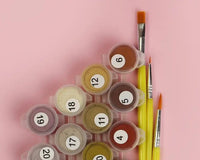
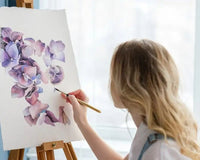
Most of the frustration people report with paint by numbers has nothing to do with painting ability. It comes from the setup, because hunting for the right pot among twenty-four, losing track of which color you were on, or working in poor light turns a relaxing hobby into a chore. A little time spent arranging the workspace before the first brushstroke pays off across every session that follows.
Start With the Palette Layout
The pots in a kit are numbered, but they arrive in no particular order, and the numbering rarely follows the order in which you will paint them. That mismatch is the single biggest cause of wasted time, so the first task is to impose an order that matches how you actually work. Sorting takes two minutes and saves that time back in the very first session.
Lay every pot out in front of you and sort them by number, reading the labels rather than guessing from the color in the pot. The printed color is often slightly different from the paint inside, and a pot that looks green on the label may be closer to olive once it is on the canvas. Sorting by number also tells you immediately whether a pot is missing before you start painting, which is far easier to resolve before the canvas is half-finished.
A brush holder and cleaner combo at $16.50 is not essential, but it solves the problem that most often interrupts a session, which is a brush rolling off the table or drying out while you look for the next pot. If you would rather not buy one, a jar with a folded cloth in the base works well enough. The test of whether you need one is simple: whether you have already lost a brush behind the sofa during a painting session.
Working in Short Sessions
Paint by numbers suits short sittings better than long ones, and the setup should be built around that. Twenty minutes in the evening is enough to complete one section, and stopping at a section boundary leaves the canvas in a state that is easy to pick up again the following day. Stopping mid-section is harder to resume because you have to work out where you were. That single decision about where to stop matters more to how quickly a project progresses than how many hours you spend on it.
The practical consequence is that the kit needs to be closeable within a minute. That means the pot lids seated fully, the brush rinsed and laid flat rather than standing in water, and the canvas covered if the workspace is somewhere dust can settle. A kit that takes ten minutes to put away will be left out, and a kit left out is a kit whose paint dries. Standing a brush upright in a jar of water is the most common mistake here, because the tip bends and the ferrule eventually loosens.
If you paint at a table that has to be cleared for meals, a protective painting apron at $20.50 and a lidded tray make the transition quick enough to actually happen. The alternative, which is leaving everything spread out, is what leads to smudged canvases and dried pots. An apron is also worth considering if you paint in clothes you care about, since acrylic marks fabric readily and is far easier to prevent than to remove.

Lighting and Posture
The numbers printed on a standard canvas are tiny, making them incredibly difficult to read in dim light. Positioning a lamp to the side instead of directly overhead eliminates harsh shadows and makes the boundaries between sections much easier to track. Additionally, if you use reading glasses, make sure to wear them. Unlike many other visual hobbies, paint by numbers requires you to constantly read small text rather than just look at a broader picture.
Posture is equally important because completing a 40x50cm or larger canvas takes hours. Painting flat on a table forces you to hunch forward and grip the brush at an awkward angle. This is the primary cause of neck and shoulder strain during long sessions. Angling the canvas toward you not only improves your visibility but also allows for a much more natural brushstroke.
An adjustable wooden table easel at $24.99 solves both issues instantly by elevating and tilting the canvas, keeping your spine aligned. If you are tackling massive 50x60cm or 60x80cm kits where the details become exceptionally fine, a precision magnifier ($37.99) is a game changer. It is one of the few accessories that physically improves what you can see rather than just adding comfort. However, if you are just working on a mini kit, you can skip both accessories because those sections are large enough to paint comfortably on a flat table.
The standard print in the kit is small, and small print is hard to read in poor light. Working under a lamp placed to one side rather than directly overhead reduces shadows across the numbers and makes the boundaries between sections much easier to follow. If you wear reading glasses, wearing them while painting matters more than it does for most hobbies because you are reading text rather than looking at a picture.
Posture matters because a canvas at 40x50cm or larger takes hours to complete. Painting flat on a table encourages leaning forward and holding the brush at an awkward angle, which is what causes most of the neck and shoulder complaints people report after a long session. Raising the canvas toward you makes the surface easier to see and keeps the brush at a more natural angle.

Keeping the Canvas Clean
Paint by numbers canvases mark easily, and a canvas with a fingerprint in the middle of an unpainted area looks worse than one with a small color error. Keeping your hand off the surface is the simplest protection, and it is easier on a tilted canvas than a flat one because your hand rests on the table rather than dragging across the print. If you do touch the surface, resist the urge to wipe it, because a smudge on unpainted canvas is far harder to hide than one on dry paint.
It is also worth working from top to bottom where the design allows it. Some people paint all of one color across the whole canvas before moving to the next, which reduces the number of times you open and close pots but increases the risk of resting a hand on wet paint. Painting by area instead keeps the wet sections contained, and it is the approach that most closely matches the numbered layout. Whichever you choose, working downward means your hand is always moving toward unpainted canvas rather than back across finished work.

What You Already Have and What Is Worth Buying
| Item | Necessary | Price | Why |
|---|---|---|---|
| Something to sort the pots into | Yes | Free | Numeric order is the single biggest time saver |
| Good light at one side | Yes | Free | Small numbers are hard to read in shadow |
| Lidded tray or shallow box | Helpful | Free | Makes closing the kit quick enough to happen |
| Adjustable table easel | Helpful | $24.99 | Improves posture and visibility on larger canvases |
| Brush holder and cleaner | Helpful | $16.50 | Keeps brushes in reach and prevents dried tips |
| Protective apron | Optional | $20.50 | Useful if the workspace has to be cleared for other use |
| Precision magnifier | Optional | $37.99 | Only needed on large canvases with fine detail |
The pattern in that table is worth noticing. The two items that make the most difference cost nothing, and the paid accessories are about comfort and convenience rather than capability. Anyone setting up for the first time should start with the free steps and add the paid ones only when a specific problem shows up during painting.

Frequently Asked Questions
Do I need a wet palette for paint by numbers?
No. A wet palette is useful for acrylic artists who mix their own colors, but the pots in a paint by numbers kit arrive pre-mixed and matched to the canvas, so there is nothing to mix. What matters instead is keeping the pots sealed between sessions and adding a drop of water when the paint begins to thicken.
How do I keep track of which color I am using?
Work in one area at a time and keep only the pots for that area open, in numeric order, with the reference sheet visible. This sounds slower than working color by color across the whole canvas, but it reduces the number of open pots and the number of times you lose your place, and it keeps the wet sections contained. It also makes a beginner project easier to stop and restart, because you always know which section comes next.
Is an easel worth buying for paint by numbers?
It is worth it at 50x60cm and above, where the sections are small enough that leaning over a flat canvas becomes genuinely uncomfortable. At 30x40cm and 40x50cm, painting flat is perfectly workable and a tilted surface offers less benefit. If you are unsure, try one canvas flat and see whether your neck complains.
How should I store a kit between sessions?
Close every pot fully, rinse and dry the brush flat rather than standing it in water, and cover the canvas so dust cannot settle on the wet paint. Store the kit somewhere cool rather than somewhere warm, because heat accelerates the evaporation that causes paint to dry out. A lidded tray makes all of this a one-minute routine.
Does the workspace need to be permanent?
No. Most people paint at a dining table and clear it afterward, which works well provided the kit can be packed away quickly. The reason temporary setups often fail is that packing up takes long enough to be skipped, and a kit left out on a table is more likely to be damaged than one stored properly.
Setting Up Once and Benefiting Every Session
The setup that works is built around one idea: the kit should be usable and closeable in a minute. Sort the pots by number, light the canvas from one side, raise it toward you if it is larger than 40x50cm, and keep only the colors for the current area open. Almost nothing in that list costs money, and the paid accessories only matter once a specific annoyance has shown up in practice.
Start with a custom kit built from your own photo or a design from the current range, set the workspace up before the first session rather than during it, and the hobby stays relaxing rather than becoming a small logistics problem every evening. Most people find that after the first canvas the setup stops needing thought, because the arrangement that suits them has already settled into a habit.