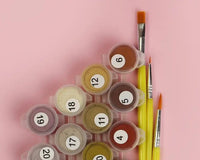
A big canvas and forty paint pots. Then the quiet fear that you bit off more than you can chew.
That moment shows up somewhere around hour three. You are staring at a half-finished sky with thirty numbered zones still blank, and the brush in your hand suddenly feels very small.
Maybe you put the kit back in the box for a few weeks. Maybe it stays there. But none of that had to happen.
The fix is a system, not raw talent. A large paint by numbers kit rewards a method more than it rewards patience alone.
Why Bigger Kits Go Unfinished
The One-Section Trap
When someone picks up one of the more advanced paint by numbers kits, the mistake is almost always the same: trying to finish one whole section before touching anything else.
You start with the sky in the top left corner. Forty-five minutes later, you are still in that corner. The color dries on the palette. The brush stiffens into a crust. By the time you circle back to the background, the momentum is gone and so is the evening.

This is the pattern that kills large canvases: working like you are filling a coloring book, zone by zone, left to right. It feels natural. It is also the slowest possible way to make progress.
Work in Passes, Not Zones
Flip the approach entirely. Do all the darkest tones first, across the whole canvas. Every number that calls for deep blue, black, dark brown. Knock them all out in one session.
Then the midtones. Then the highlights last.
This keeps every color active and your eye moving across the whole surface. The painting assembles in layers, the way a photograph develops in a darkroom, rather than piece by piece like a puzzle.
You also get to see the composition emerge early. When the darks are down and the midtones start going in, the image snaps into focus. That moment is a genuine morale boost, and on a forty-hour project, morale matters.
A side benefit: you spend less time washing brushes between color changes. Dark to dark, midtone to midtone. The flow stays unbroken.
The Gear That Actually Helps
Brushes: Three Is Not Enough
Most kits come with three brushes. A small round, a medium flat, and something in between. That setup works for most popular kits under 16 by 20 inches. Beyond that size, you want options.
A finer detail brush saves you from smudging when the numbered zones get tiny, which they do on larger pieces like the Harry Potter Hogwarts Van Gogh kit.
Some of those zones are the size of a fingernail. The brush that came in the box will not fit.

A flat wash brush covers background areas in a quarter of the time. Large skies, open water, broad fields. These sections can eat two hours with a small round. A flat brush turns them into twenty minutes.
Having extra brushes on hand means you can switch sizes without stopping to clean mid-session. Clean brushes also hold their shape longer. A brush that stays bent after a few uses was never cleaned properly between colors.
A Brush Holder Pays for Itself
A brush holder with a cleaning basin is not exciting to shop for.
But dried acrylic in a ferrule ruins a brush faster than anything else. Once the paint hardens where the bristles meet the metal, the brush splays permanently.
If you work across multiple sessions, a proper holder and rinse basin pays for itself in the brushes you do not replace. That is three or four brushes over the life of a single large kit.

Frame Before You Start
Why Stretching Matters
A common regret with larger kits: finishing the painting, stepping back to admire it, and realizing the edges are uneven because the canvas stretched as you worked.
Canvases move. They absorb moisture from the air and from the paint itself. A 20 by 24 inch surface can warp enough to make the finished piece impossible to mount cleanly.
How to Mount It Right
Stretch and mount before the first brushstroke. A wooden DIY frame keeps tension consistent and gives you a stable, rigid surface.
Lay the canvas flat, align it square, and staple from the center of each side outward. Work in small increments. This keeps the tension even and prevents diagonal warping.
The payoff is immediate: the finished piece is ready to hang the moment you sign it. No second round of stretching to risk cracking the dried paint. No wrestling with an uneven edge after forty hours of work.
How Long Does a Large Kit Actually Take
Realistic Time Expectations
A 16 by 20 inch kit with thirty-plus colors: expect twelve to eighteen hours, spread across at least a week. Longer if you blend. Longer still if you frame before starting, which you should.
Rushing is what produces visible brushstrokes, patchy coverage, and the kind of result that makes you not want to hang it. The people happiest with their large canvases are the ones who treat each session like a ritual, not a shift to get through.
Pacing Your Sessions
Two hours per evening, three or four evenings a week. That pace keeps the palette from drying out and keeps your hand steady.
Marathon sessions on a weekend sound productive but lead to fatigue. Mistakes creep in. A shaky hand on hour six undoes the clean lines from hour two.
Your eyes also lose the ability to judge color accurately after prolonged focus. The paint does not dry faster just because you are in a hurry.
A Wall Worth Earning
The finished painting sits differently in a room than a small canvas does. It reads as intentional decor, not a craft project. Guests ask about it. You know every brushstroke, every near-mistake, every zone you almost skipped.
That shift from "something I made" to "something that belongs on the wall" is the whole point of going bigger. A large kit asks for patience and a little planning.
What it gives back is a piece that holds a room and a memory that outlasts the hours you put in.